Why Is Process Street the Best for Ease of Implementation?
Teams often spend weeks switching between tools before any process runs reliably. Many platforms promise quick starts yet require custom code or long training sessions before teams see consistent results.
By the end of this article you will know exactly how Process Street sets up workflows, document controls, and compliance checks without extra development work. You will also see which pricing tier matches your team size and what proof of compliance the platform can deliver in an audit.
What Is Process Street?
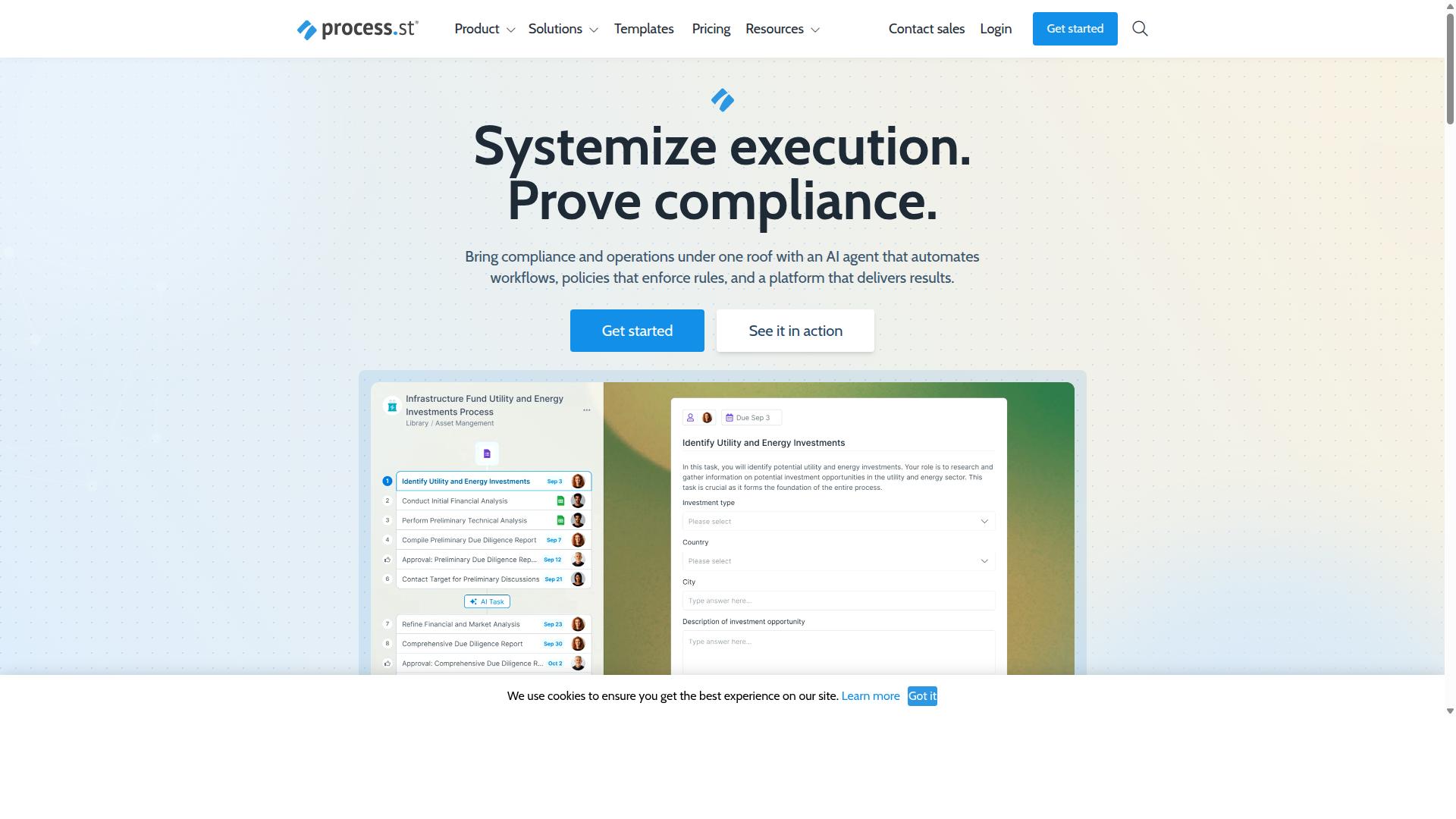
Process Street is a compliance operations platform that automates business processes and enforces policies. The platform delivers audit-ready proof while helping organizations maintain operational consistency across industries.
Three main products form the core offering. Docs handles document management and policy control. Ops manages workflow automation and process orchestration. Cora serves as an AI compliance and risk agent.
The primary value proposition centers on standardization and compliance. Organizations use the platform to prove compliance while maintaining operational consistency across different industries and regulatory environments.
Why Process Street Excels at Ease of Implementation
Implementation time is shortened through built-in templates and a no-code interface.
Three concrete steps make setup straightforward. First, select a template from the library. Next, customize fields and permissions with drag-and-drop. Finally, publish the workflow and assign it to team members.
Users at IMCD UK reported a 75% reduction in setup time when they adopted this approach. The savings came from skipping manual configuration and moving directly to process execution.
Drag-and-drop tools remove the need for coding. Process Street users arrange tasks visually, while templates supply ready-made structures for common workflows like onboarding and approvals.
This combination keeps the entire rollout within a single platform. Teams avoid external developers, lengthy testing cycles, and custom integrations that slow down other tools.
Key Features and What Makes Process Street Stand Out
The platform differentiates itself through three integrated product lines that address both workflow execution and policy governance.
Organizations need tools that connect policy creation with daily task execution. Process Street accomplishes this through coordinated products that work together without requiring complex configuration steps.
Each product line handles specific aspects of business operations while maintaining consistency across the platform. This approach reduces the learning curve and accelerates deployment across teams.
Workflow Automation and Process Orchestration
Ops turns static policies into AI-powered workflows that trigger tasks, approvals, and reminders automatically.
The automation converts documented procedures into active processes that teams execute consistently. This eliminates the gap between written policies and actual operational practices.
Approval workflows can handle expense requests that require manager sign-off before processing. Budget allocations may need multiple department heads to review and approve before funds release.
The Startup plan includes access to 10 automation apps that connect with external systems. These connections allow data to flow between Process Street and other business tools without manual intervention.
Document Management and Policy Control
Docs provides document governance that meets ISO 9001, SOC 2, SOX, and FDA requirements.
Versioning controls track every change made to policies and procedures over time. Teams always work with the most current approved versions while maintaining access to historical iterations when needed.
Audit trails record who accessed documents and what modifications occurred. Permission settings determine which users can view, edit, or approve specific policy documents based on their organizational roles.
These controls ensure consistent policy application across departments. Compliance requirements become built-in features rather than separate oversight processes.
AI Compliance Monitoring
Built-in AI continuously monitors workflow runs for compliance deviations and surfaces them on the dashboard.
The monitoring system examines completed workflows against established policy requirements. When deviations occur, the AI generates alerts that notify relevant team members about potential issues.
Dashboard displays quantify compliance metrics across different workflow categories. Teams can identify patterns in non-compliance and address root causes before they become systematic problems.
This continuous oversight reduces the manual review burden while maintaining regulatory standards. Compliance becomes an ongoing operational function rather than periodic audit events.
Pricing and Plans
Three pricing tiers offer increasing automation and data capacity for teams of different sizes. Each tier builds on the previous one with added capabilities that support growing operational needs.
The Startup plan provides a simplified Pro experience designed for new businesses. Users get unlimited workflows and tasks, access for five people, and a maximum of 5,000 Data Set records. This tier also includes 10 automation apps with 100 automation actions per month and 50 Public API calls monthly.
The Pro plan removes most restrictions and scales with team growth. Organizations benefit from unlimited workflows, custom user counts, and up to 10,000 Data Set records. All automation apps become available with custom monthly automation actions and API call limits.
Enterprise customers receive a fully managed solution with custom Data Set records and unlimited Public API access. This tier includes a dedicated Success Manager, priority support, and process consulting services that help during implementation and ongoing use.
Trust Signals
SOC 2 Type II and ISO 27001 certifications provide verifiable third-party assurance of data protection. These credentials confirm that Process Street follows strict controls around access, encryption, and monitoring. Companies gain confidence knowing independent auditors reviewed their practices.
Global data residency options allow organizations to store information in regions that match their regulatory needs. This flexibility supports compliance across borders without extra configuration steps. Teams maintain control over where sensitive content lives.
Over 3,000 companies and 1,000,000 users already rely on the platform for daily operations. This adoption rate signals that organizations find the implementation path straightforward and repeatable. Existing users reduce uncertainty for new teams evaluating the service.
Who Should Use Process Street
Operations, compliance, HR, finance, and IT teams in regulated industries benefit most from standardized process execution. Process Street serves these exact departments across multiple sectors that require consistent workflows and documentation control.
Financial services and capital markets organizations use Process Street for client onboarding and compliance tracking. Real estate and property management companies apply the platform to document control and quality tracking across multiple properties.
Manufacturing and healthcare facilities rely on Process Street for ISO compliance and quality management. Professional services and technology companies implement the platform for employee onboarding and custom workflow creation.
The six target departments each handle distinct processes that benefit from structured execution. Operations teams manage production workflows and quality assurance. Customer management handles client relationships and service delivery.
Compliance departments track regulatory requirements and audit documentation. Human resources coordinates employee onboarding and policy distribution. Finance teams process approvals and financial controls. IT and security manages system access and security protocols.
Process Street supports all six use cases through templates designed for employee onboarding, client onboarding, ISO compliance, quality tracking, document control, and custom workflows. This structure allows teams to implement standardized processes without extensive configuration.
Final Verdict
Process Street delivers measurable ROI through reduced setup time and audit-ready documentation. Teams that adopt this platform often see faster rollout cycles and fewer implementation roadblocks.
Three main benefits stand out. Quick setup lets users configure workflows without heavy IT involvement. Audit-ready documentation keeps records organized and compliant. Responsive support ensures ongoing assistance when questions arise.
Documentation processes run up to 30% faster compared to manual methods. This speed advantage compounds when teams scale their operations or add new users.
Contact sales is available for organizations ready to explore implementation. Average response times are five minutes through email and chat, backed by a 98% customer rating. Process Street is also listed on AWS Marketplace for those who prefer that procurement route.